


The warming of the past several decades has led to many changes in the water cycle including changes in precipitation patterns and intensity, greater frequency and extent of drought, widespread melting of snow and ice, increasing atmospheric water vapor, increasing evaporation, increasing water temperatures, reductions in lake and river ice, and changes in soil moisture and runoff. Impacts of these changes include too much water in some places and times, and too little in others.
In general, precipitation is becoming less frequent but more intense. The resulting heavy downpours increase the risk of flooding and erosion. The longer periods of time between rain events, coupled with higher air temperatures, mean more drought conditions.
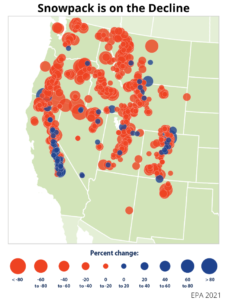
Observed trends in April snowpack measured in snow water equivalent. Red circles are decreases, Blue circles are increases.
In addition, global warming is causing precipitation patterns to shift geographically. Generally, higher latitudes are projected to receive more precipitation. Increases in tropical precipitation are projected during rainy seasons, such as monsoons. The dry belt that lies just outside the tropics is expanding further towards the poles, and is expected to receive less rain. This means that regions including the North American Southwest and the Mediterranean are projected to become drier.
These changes will have direct consequences for water security. A recent study estimates the number of people exposed to water stress could double by 2050 if population growth is high and global warming is not kept from exceeding 2ºC (3.6ºF) above pre-industrial levels. Even if the world meets the Paris Agreement’s temperature target, and population growth is low, the number of people exposed to water stress could still rise by 50% by 2050, compared to 2010.
Almost a quarter of the world’s people currently depend on water from glaciers and snowpack, and these water supplies are declining, reducing water availability in regions supplied by meltwater from major mountain ranges. Mountain snowpack plays a key role in western North America, storing water in the winter when snow falls and releasing it as runoff in spring and summer when the snow melts. In the U.S., millions of people depend on water from mountain snowpack for hydropower, irrigation, and drinking water, but large and consistent decreases in snowpack have been observed and are especially prominent in Washington, Oregon, northern California, and the northern Rockies.
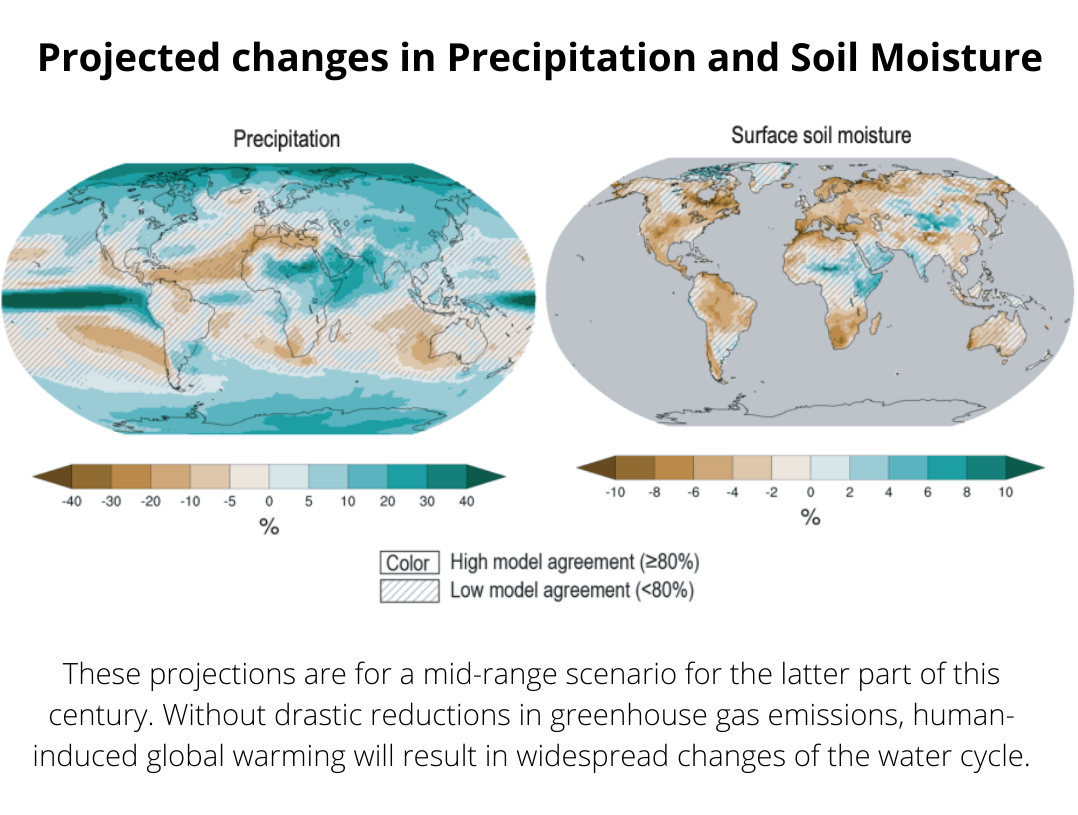
These projections for spring precipitation in North America are for a scenario (A2) that assumes continued increases in heat trapping gas emissions. They show large increases of precipitation over the North, particularly the Northeast, and large decreases over the South, particularly the Southwest. Higher temperatures and reduced precipitation over the Southwest suggest increased drought risk.


