


Businesses large and small are committing to climate and sustainability actions. Reducing energy use and optimizing operations save money and resources. This is good news for both the companies and the climate. Clients and customers are considering corporate responsibility and sustainability strategies and are increasingly supporting more environmentally conscious businesses. Shareholders and investors are increasingly seeking climate-related financial risk information. Companies can foster increased productivity and innovation and attract engaged, talented staff who want to work for a business with strong environmental values. Taking ambitious climate action can help businesses take advantage of tax incentives and stay ahead of future policy changes.
While it’s good that many companies are announcing climate and sustainability goals, it is also important to recognize and call out greenwashing. If a company spends more on marketing their green credentials than actually implementing their climate goals, they may be greenwashing. We must continue to hold companies accountable and demand strong, bold climate goals.
What are businesses doing?
Committing to carbon neutrality/net zero emissions, which means the greenhouse gases emitted by a business are balanced by their efforts to remove carbon from the air. This is not the same as “absolute zero,” which would mean they do not emit any carbon pollution. Transparency and monitoring are key to ensuring the effectiveness of corporate efforts. Strong implementation strategies must also accompany corporate climate commitments. A few examples are highlighted here.
In short, scope 1 is what you burn; scope 2 is what you buy; and scope 3 is everything beyond that. Scope 1 means direct emissions from sources owned or controlled by a company. Scope 2 refers to indirect emissions from energy purchased by a company. Scope 3 includes all other emissions associated with a company’s activities, such as those from products like coal, oil, and gas sold to and used by its customers.
- Apple has already reached carbon neutrality for their operations and plans to achieve this goal for their entire footprint by 2030.
- Maersk, a global shipping and logistics company, has committed to achieving net zero emissions across their entire business and all scopes by 2040. It is a founding member of Transform to Net Zero, a cross-sector initiative to accelerate the transition to a net zero global economy.
- Intel has committed to reach net-zero greenhouse gas emissions across its operations by 2040.
Transitioning to 100% renewable electricity
-
- Google matches 100% of its global electricity use with purchases of renewable energy.
- Microsoft purchases clean power equal to their global electricity consumption. By 2025, they will shift to 100% use of renewable energy.
- Intel plans to achieve 100% renewable electricity use across its global operations by 2030.
Using only recycled and renewable materials, enhancing material recovery practices
-
-
- By 2030, Microsoft pledges to divert at least 90% of the solid waste headed to landfills and incineration from its campuses and data centers and achieve a minimum of 75% diversion of construction and demolition waste for all projects.
- Apple plans to eliminate plastics in their packaging by 2025.
Companies can purchase “carbon credits” or “carbon offsets” to achieve their net zero targets without eliminating all of their carbon emissions. An organization can balance its emissions by investing in natural climate solution projects that store carbon, such as forest preservation and better farming methods, or projects that reduce the use of fossil fuels such as wind farms and solar cookstoves. High quality carbon offsets can help businesses meet their climate goals, especially in industries that are difficult to decarbonize like long-haul aviation. But not all offsets are credible and can contribute to businesses greenwashing, so transparency tools like Carbon Credit Quality Initiative and local partnerships are important to ensure the effectiveness of natural climate solutions investments. It’s important to still hold companies accountable for their emissions, while investing in nature based solutions can be a helpful addition, the primary focus should be on eliminating fossil fuels.
-
Investing in natural climate solutions
- Amazon established the Right Now Climate Fund with $100 million pledged to reforestation, conservation, and nature-based solutions, including $10 million to restore and conserve four million acres of forest in the Appalachians and other U.S. regions in partnership with The Nature Conservancy.
Investing in new, renewable energy projects
-
- In 2019, Google invested more than $2 billion in 18 new energy infrastructure deals, including millions of solar panels and hundreds of wind turbines spread across the U.S., Chile, and Europe. These are long-term purchase commitments that result in the development of new projects.
Partnerships
-
- Google partners with the United Nations to help people find accurate climate change information.
Inventing new, creative practices to improve operations while reducing carbon emissions
-
- CarbonCure is on a mission to make concrete a climate solution and reduce embodied carbon in the built environment by 500 million tonnes annually by 2030. In addition to sequestering CO2, their concrete comes out stronger. Cement (the basis of concrete) is now responsible for about 7% of global carbon emissions; this has doubled in the past two decades and more than tripled since 1992.
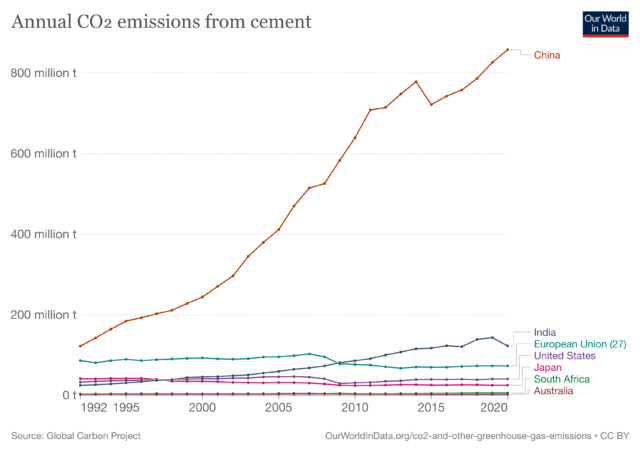
Annual cement emissions from 1992 to 2020


