


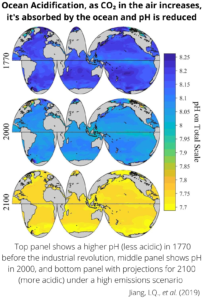
In addition to carbon dioxide’s heat-trapping effect, it also affects our oceans and everything that lives in and depends upon them. As the oceans absorb carbon dioxide from the air, the chemistry of the water is altered, gradually acidifying the oceans, in a process known as ocean acidification.
To date, the ocean has absorbed about 20-30% of humanity’s CO2 emissions. Ocean waters are now about 30% more acidic than they were before our burning fossil fuels and clearing of forests began adding excess carbon dioxide to the atmosphere. As this acidification continues, less calcium becomes available to living things in the ocean that form shells or skeletons from calcium carbonate. This poses a threat to shellfish, corals, and plankton species that form the base of important marine food chains. Ocean acidification is already decreasing both coral extent and diversity, and these impacts can be made even worse by rising ocean temperatures. The effects of acidification will continue to affect marine life in the deep ocean even if atmospheric CO2 levels are stabilized or reduced.
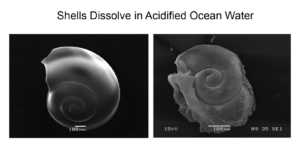
Pteropods, or “sea butterflies,” are free-swimming sea snails about the size of a small pea. The photos above show what happens to a pteropod’s shell in seawater that is too acidic. The left panel shows a shell collected from a live pteropod from a region in the Southern Ocean where acidity is not too high. The shell on the right is from a pteropod collected in a region where the water is more acidic (Photo credits: (left) Bednaršek et al. 2012; (right) Nina Bednaršek). NCA 2014


