


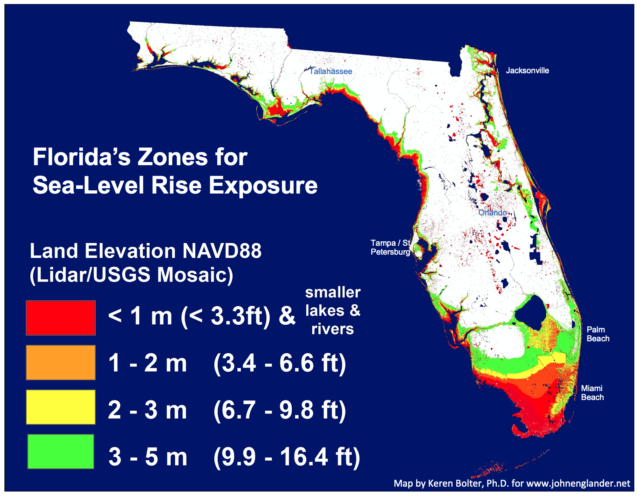
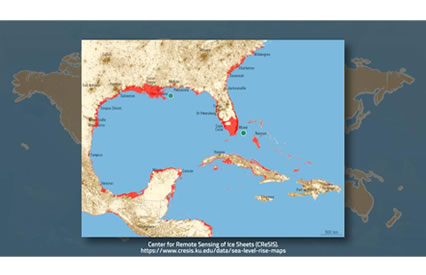


Sea-level rise exposes coastlines to greater risks of flooding and erosion and is expected to affect millions of additional people each year by late this century. Small islands such as the Maldives, Asian mega-deltas such as in Bangladesh, low-lying coastlines in the United States along the Southeast and Gulf of Mexico, and heavily populated coastal cities in Europe such as London and Venice are among the vulnerable locations. Some small island nations could disappear entirely. Portions of some major coastal cities may have to be abandoned. Differences in coastline geography, ocean currents, land subsidence, and other factors are causing some areas—including the U.S. East and Gulf Coasts—to experience greater sea level rise than others. Many U.S. cities, such as Miami, will experience greater sea level rise than the global average.
Nearly 40% of the U.S. population lives in densely populated coastal areas, where sea-level-rise-related increases in flooding, shoreline erosion, and storm surge threaten infrastructure critical to local jobs and regional industries, such as water and sewer systems, roads, and power plants. Disadvantaged communities, Indigenous Peoples, and coastal ecosystems are especially vulnerable to sea level rise impacts. As sea levels have risen, the annual number of high tide floods (sometimes referred to as “sunny day floods”) has increased 5- to 10-fold since the 1960s in some U.S. coastal cities including Charleston, SC; Honolulu; Philadelphia; and San Diego. Projections indicate that tidal flooding will continue to increase in depth, frequency, and extent throughout this century and beyond due to climate change.
Coastal wetlands, including salt marshes and mangroves, are very sensitive to sea-level rise, and large parts of these ecosystems are projected to be lost around the world. The largest losses are likely to be on the Atlantic and Gulf of Mexico coasts of the Americas, the Mediterranean, the Baltic, and small-island regions.
As global temperatures continue to increase, sea level will continue to rise. The rates of future heat-trapping greenhouse gas emissions and hence global warming will determine how much and how fast it will rise.


