


Climate change poses a tremendous scientific, economic, diplomatic, and ethical challenge to humanity. Today, we continue to pump heat-trapping gases into the atmosphere that will still be there thousands of years from now. This means that climate protection is our mutual responsibility. Working together at the personal, local, national, and international levels, our task is to redesign the energy basis of our civilization, while simultaneously adapting to the warming we have already caused. Our species has never faced a challenge quite like this. In a sense, it is the greatest journey we have ever embarked upon.
To paraphrase former Presidential Science Advisor John Holdren, we will have to do three things in response to climate change: mitigate (reduce emissions to curb future warming), adapt, and suffer. We’re going to do some of each. The question is what the mix will be. The more mitigation we do, the less adaptation will be required and the less suffering there will be.
The science is clear: climate disruption will continue to accelerate until we stabilize atmospheric concentrations of greenhouse gases. The longer we delay action, the worse the problem gets and the more expensive it becomes to solve. Not long ago we were aiming to avoid dangerous human interference in the climate system. Unfortunately, strong action was delayed for too long, and we are now experiencing such disruption. Dangerous climate change is here. But we can still avoid a global catastrophe if we act aggressively now.
John Holdren has also said that we must manage the unavoidable, and avoid the unmanageable. This means we must adapt to the impacts of climate disruption that are already occurring while assuring that future climate change does not exceed our ability to cope.
Energy infrastructure, like carbon dioxide, is long-lived. A typical fossil-fuel-fired power plant will operate for 40 to 60 years. Likewise, buildings designed today will be consuming energy long past mid-century. Because today’s decisions will outlive us, it is critical that we move to clean energy and low-carbon solutions immediately. That means no new fossil fuel infrastructure.
Given the nature of this problem – that it only gets worse the longer it is ignored – it seems inevitable that humanity will, sooner or later, act to reduce its influence on climate. So why not get started now? If we continue to procrastinate, future generations are likely to look back and ask, “What were they thinking? What took them so long?”
If, on the other hand, the world comes together to reduce emissions, end deforestation, and build a sustainable, clean energy economy, our children and grandchildren will offer us their gratitude, for by vanquishing the threat of climate change we will have given them a precious and enduring gift.
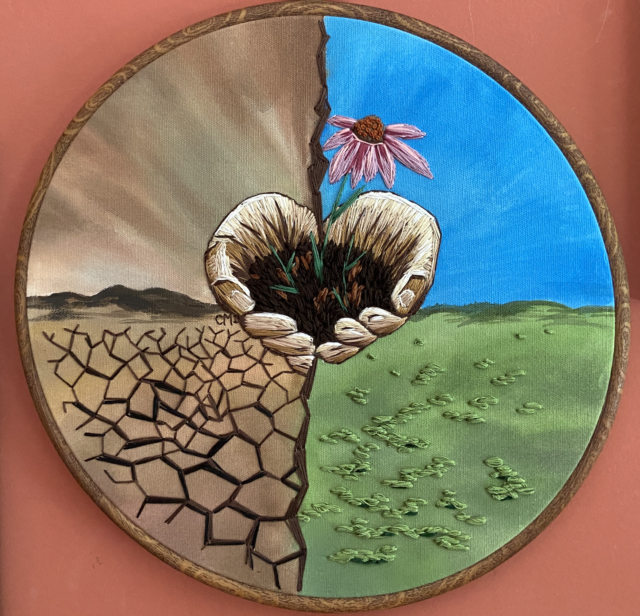
Susan Joy Hassol often reminds people that the future is in our hands. DOE scientist Colleen Iverson, of Oak Ridge National Lab made this embroidery for Susan in thanks for the workshop we led for DOE early career scientists in May 2022.

Dr. Iverson also made this embroidery of a musk ox for Susan after a Twitter exchange in which scientist Jacquelyn Gill evoked the musk ox as a symbol of strength and resilience as we work for action on climate change. #TeamMuskOx


